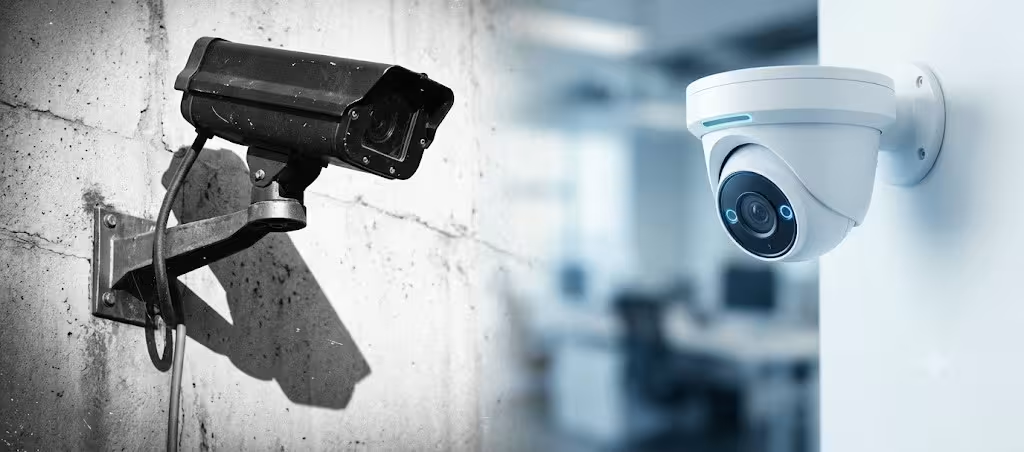
A video surveillance system captures, transmits, manages, and stores video within a closed circuit: only authorized users can access the content, unlike an open broadcast. It’s used to deter incidents, provide physical security, optimize operations, and generate auditable forensic evidence. Any such system rests on four components: the camera (the optical sensor), the transmission medium (coaxial, UTP, fiber, or radio frequency), the recording and storage subsystem, and the display and management layer (monitors, VMS, control centers).
Here’s the timeline of how we got here.
The origins: military surveillance with no recording (1927-1960s)
The earliest documented closed-circuit system dates back to June 1927: Russian physicist Leon Theremin built a mechanical shortwave transmitter-and-receiver system, with a resolution of just 100 lines, installed in the Moscow Kremlin’s courtyard to monitor visitors before letting them in (Clarion Security Systems).
The design that defines modern CCTV arrived in 1942, in Peenemünde, Germany. Siemens engineer Walter Bruch installed a closed-circuit system at Test Stand VII to observe V-2 rocket launches from a safe distance (Fastech Ltd). It was purely analog technology — bulky vacuum-tube cameras — with zero recording capability. Monitoring had to happen live, with a human operator watching the screen in real time.
The leap to civilian use happened in the United States in 1949, with Remington Rand’s Vericon system (designed by CBS Laboratories). It was marketed with a concrete commercial argument: because it traveled over coaxial cable instead of broadcasting over the air, it didn’t require a government license (ENS Security).
Through the 50s and 60s, the technology gradually worked its way into urban life: Hamburg used CCTV for traffic monitoring starting in 1956, and in the 60s, Liverpool police and the London Underground ran covert trials to deter crime (Wikipedia — Closed-circuit television). In residential security, the key milestone came in 1969, when the first home security system patent was granted to Marie Van Brittan Brown: cameras mounted on rails, peepholes, and monitors for identifying visitors remotely (San Diego Squared).
The analog era: CCD sensors and tape recording (1970s-1990s)
Two developments drove CCTV’s commercial explosion in the 70s and 80s: smaller sensors and long-duration magnetic recording.
Before this, cameras relied on fragile, bulky tubes like RCA’s Vidicon. That changed with the invention of the CCD sensor (Charge-Coupled Device) in 1969 at Bell Labs. The commercial transition came in 1973, when Fairchild released the MV-100, the world’s first commercial CCD camera, with a modest resolution of 100x100 pixels (Digitalkamera Museum — World’s Firsts). The smaller size and the elimination of vacuum tubes accelerated corporate adoption.
On the storage side, the mass adoption of VCR cassette recorders in the 70s turned CCTV into a forensic tool: banks and businesses no longer needed constant human monitoring — they could archive footage and review it after an incident (Felenasoft — Xeoma). The logistical problem — the sheer volume of physical tapes, and the inability to record multiple cameras at once — got solved in the 90s with video multiplexers, which synchronized up to 16 channels onto a single VCR by interleaving frames.
During this era, Japanese corporations (Sony, Panasonic, JVC) dominated hardware manufacturing, all built on a coaxial-cable foundation.
The digital transition: the DVR and the first IP camera (1990s-2000s)
In 1992, German manufacturer Dallmeier developed the first Digital Video Recorder (DVR), bringing hard-disk storage to commercial video surveillance (Dallmeier electronic). The DVR received the analog signal, digitized it, and compressed it — initially using Wavelet algorithms — enabling instant search by date or event without rewinding tape.
The decisive step toward networks came in 1996: Swedish company Axis Communications launched the AXIS Neteye 200, the world’s first IP camera (Axis’s official history). It packed a built-in web server and a RISC microprocessor, producing JPEG frames at CIF resolution (352x288) at a maximum of 1 frame per second. It didn’t stream smooth real-time video, but it proved an optical sensor could connect directly to a data network or the Internet, no coaxial cable required.
In 1999, German company Mobotix pushed the idea further with the first fully decentralized IP camera: an embedded Linux OS handling alarms, internal-memory recording, and event logic without needing a DVR or centralized server — an early pioneer of edge computing in surveillance (Mobotix — 25 Years).
The migration from analog to IP depended on compression standards catching up. MJPEG compressed each frame independently and quickly saturated the bandwidth of early Ethernet networks. The breakthrough came with inter-frame compression — MPEG-4, and above all H.264 — which only transmitted the pixels that changed between frames, making large-scale IP adoption financially and operationally viable over shared LANs.
The IP era matures: NVR, VMS, and ONVIF (2000s-2010s)
Coaxial cable gave way to structured UTP cabling, and with it came Power over Ethernet (PoE): power and data over a single cable, cutting installation costs and time dramatically.
The DVR was displaced by the NVR (Network Video Recorder). Unlike its predecessor, the NVR doesn’t digitize anything — it simply receives, manages, and stores video streams that arrive already digitized and compressed from IP cameras.
As corporate deployments scaled to hundreds or thousands of cameras across multiple cities, software started to matter more than recording hardware. That’s what launched VMS (Video Management Software) platforms: Canadian company Genetec launched Omnicast in 1997, and Danish company Milestone Systems (founded in 1998) introduced XProtect in 2002. These hardware-agnostic platforms let integrators unify cameras, access control, and intrusion systems from dozens of different manufacturers under a single interface.
The rapid spread of IP systems created a serious interoperability problem: every manufacturer used its own proprietary protocol. In 2008, Axis, Bosch, and Sony backed the creation of ONVIF (Open Network Video Interface Forum) to standardize communication between cameras, NVRs, and VMS platforms from competing brands.
Despite IP’s technical dominance, there was still a massive installed base of coaxial cable that end users were reluctant to rip out. To serve that lucrative transition market, around 2012 Chinese manufacturer Dahua Technology introduced HDCVI, an analog modulation scheme that enabled high-definition video transmission over existing coaxial cable (camarasdevigilanciaip.es). Even so, by 2014 global revenue from IP cameras is estimated to have overtaken analog cameras [market estimate, no single verifiable primary source found in this research].
The current era: AI, the cloud, and AIoT (2010s-present)
Cameras stopped being passive evidence-capture devices and became proactive sensor nodes in the Internet of Things, heavily driven by artificial intelligence.
Video content analytics (VCA) is the defining development of this stage. Manufacturers like Intellio laid early groundwork starting in 2005 — line-crossing detection, wrong-direction detection — though these early systems suffered from frequent false alarms triggered by lighting changes or weather [claim from the original research, no direct source found in the citation list]. That changed with the integration of neural networks and deep learning into embedded camera processors. Today, AI-powered analytics run locally (Edge AI) for facial recognition, license plate reading (LPR/ANPR), directional people counting, and object classification.
On the optics side, 4K became a commercial standard in the early 2010s, and 8K sensors are already on the market — the AXIS Q1809-LE captures up to 33 megapixels per frame (Axis Newsroom). Multi-sensor lens arrays also exist, like Dallmeier’s Panomera system, which stitches together multiple fixed lenses to generate high-resolution panoramas without mechanical moving parts.
Architecture has also shifted to the cloud with the VSaaS model (Video Surveillance as a Service), offloading processing and long-term storage to remote data centers. And with that hyperconnectivity comes a cybersecurity challenge: a modern IP camera is, essentially, a computer with a lens attached to the network — which means enterprise deployments now require end-to-end encryption, port hardening, and regulatory compliance (such as GDPR).
Key brands by era
| Era | Influential manufacturers | Contribution |
|---|---|---|
| Pioneers (1940s-1950s) | Siemens, Remington Rand | First functional tactical CCTV (1942); first commercial system, Vericon (1949) |
| Analog leaders (1970s-1990s) | Fairchild, Sony, Panasonic, JVC, Bosch | First commercial CCD sensor (1973); Japanese dominance of hardware |
| Digital innovators (1990s-2000s) | Dallmeier, Axis, Mobotix, Intellio | First DVR (1992); first IP camera (1996); decentralized architecture (1999); edge VCA (2005) |
| Software ecosystem (2000s-2010s) | Genetec, Milestone | Omnicast (1997) and XProtect (2002) shifted the industry’s value toward open VMS platforms |
| Current leaders (2010s-present) | Hikvision, Dahua, Hanwha Vision, Axis, Motorola Solutions | Hikvision and Dahua hold the largest global volume market share; Hanwha Vision leads with proprietary AI chips; Axis and Motorola lead in cybersecurity and cloud analytics in Western markets [competitive-positioning claim, not verified against market figures] |
FAQ
Who invented the first video surveillance system? The first documented closed-circuit system was built by Leon Theremin in 1927 for the Kremlin. The first system with the functional design we now recognize as CCTV was installed by Walter Bruch (Siemens) in 1942, in Peenemünde, to monitor V-2 rocket launches.
When was the first IP camera created? In 1996, when Axis Communications launched the AXIS Neteye 200.
What’s the difference between a DVR and an NVR? A DVR receives an analog signal, digitizes it, and compresses it internally. An NVR receives video that’s already digitized and compressed from IP cameras — it doesn’t digitize anything, it just manages and stores.
What is HDCVI and why does it exist? It’s an analog modulation technology from Dahua Technology (2012) that transmits high-definition video over existing coaxial cable, extending the useful life of analog installations instead of requiring a full migration to IP.
When did IP cameras overtake analog cameras in sales? IP camera revenue is estimated to have overtaken analog camera revenue globally around 2014 (a market estimate, not verified against a single primary source).
Sources consulted
- Clarion Security Systems — CCTV history
- Fastech Ltd — military history of CCTV
- ENS Security — what is CCTV, a brief history
- Wikipedia — Closed-circuit television
- San Diego Squared — Marie Van Brittan Brown
- Digitalkamera Museum — Fairchild MV-100
- Digitalkamera Museum — World’s Firsts
- Felenasoft — evolution of video surveillance (Xeoma)
- Dallmeier electronic — Corporate Portrait
- Axis Communications — History
- Digitalkamera Museum — Axis NetEye 200 (1996)
- Mobotix — 25 years of decentralized technology
- Genetec — About us
- Milestone Systems — History
- camarasdevigilanciaip.es — HDCVI, HDTVI, AHD differences
- Axis Communications Newsroom — 8K cameras
- Tecnoseguro — Dallmeier Panomera at Security Essen 2012